The Engineerium
About: A playable open-world POI, built in Unreal 5.
Background:
This project was inspired by The British Engineerium, a Victorian Water Pumping Station in Hove, Sussex. Having passed this building countless times through my nearby park I felt compelled to reimagine it as a playable space. Its distinctive chimney, elevated position, and gradual reveal through the surrounding trees made it feel like a natural open-world landmark.
My goal was to create an authentic POI for a fictional open-world game with a readable, intuitive design that encourages exploration and rewards player curiosity.
Gameplay Overview
Main Objective: Restart the Engine Room Flywheel
The player enters the Main Engine Room and sees that a Flywheel Control Key is required to restart the machinery.
Outside by the cooling pool, they discover a locked Maintenance Building with open roof windows.
They use a nearby crate to climb onto the roof and drop inside, where the Water Valve can be found.
The Water Valve is then used to drain the pool, revealing the Flywheel Control Key at the bottom.
The player returns to the Main Engine Room and can now start up the flywheel.
This reveals a new climbable route leading to a reward to collect.
Video walkthrough:
Secondary Objective: Explore The Engineerium for Resources
The player can explore The Engineerium to discover optional resources and rewards.
Video playthrough:
The process
Phase 1: Research & First Pass Blockout
One of my favourite parts of any level design project is the research phase. I enjoy grounding my designs in real-world reference, using Miro to gather and organise inspiration from a range of sources. For this project, I was able to visit the British Engineerium to capture my own reference photography and better understand it’s architecture and inner workings. I add notes to the reference images to highlight any elements that could influence the layout, gameplay, or environmental storytelling.
During this phase, I also created a basic exterior blockout to establish the POI's footprint, metrics, and overall layout. Although the building grew significantly as the interiors developed, this initial pass established the building's silhouette and the arrangement of the surrounding exterior spaces. Once I had established the initial layout, I mapped my reference images to each area of the blockout to help define the identity and purpose of every space and then I began the next phase.
Phase 2: Blockout & Iteration
With the overall layout established, I began by developing the interior spaces. I wanted each room to have a distinct identity and purpose while remaining connected through a clear and readable layout. Inspired by the real Engineerium, I designed the building around a central boiler room, with the two large engine rooms positioned on either side. Throughout this phase, I constantly played through the level, evaluating every possible route and considering how each space felt to explore. As this was designed as an open-world POI, I wanted to give the player meaningful route choices and ensure the space flowed well regardless of the direction they approached from.
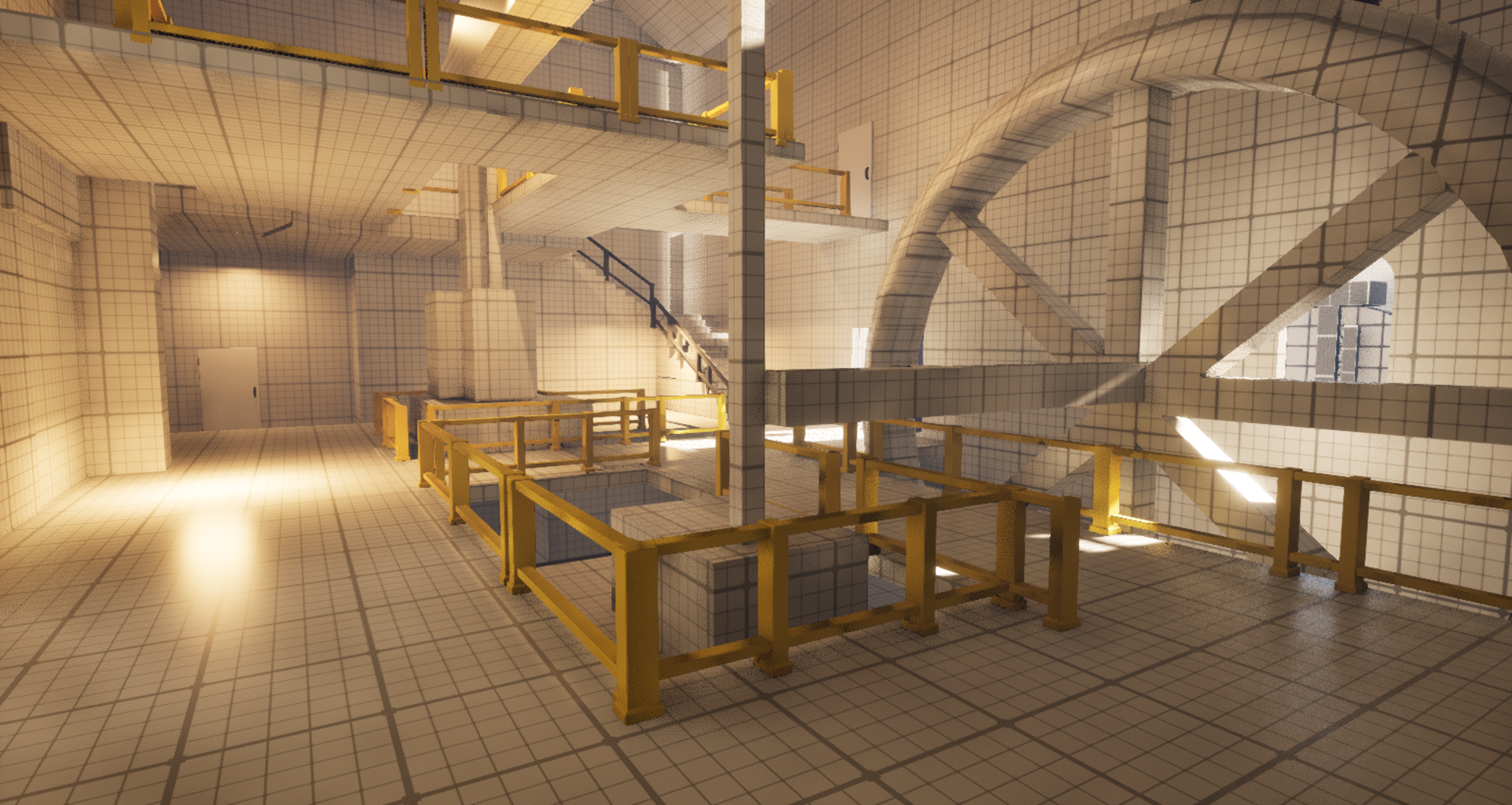
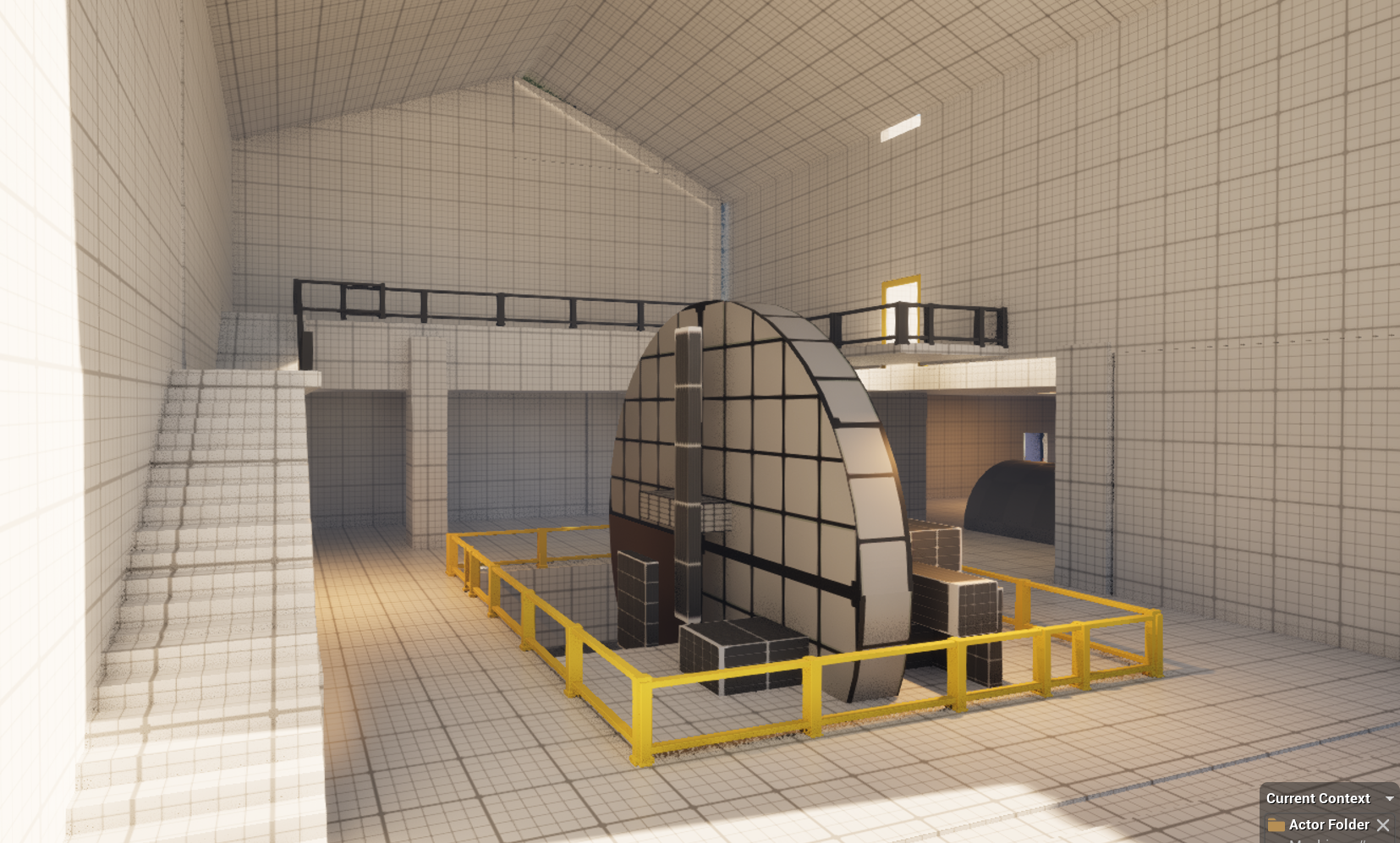
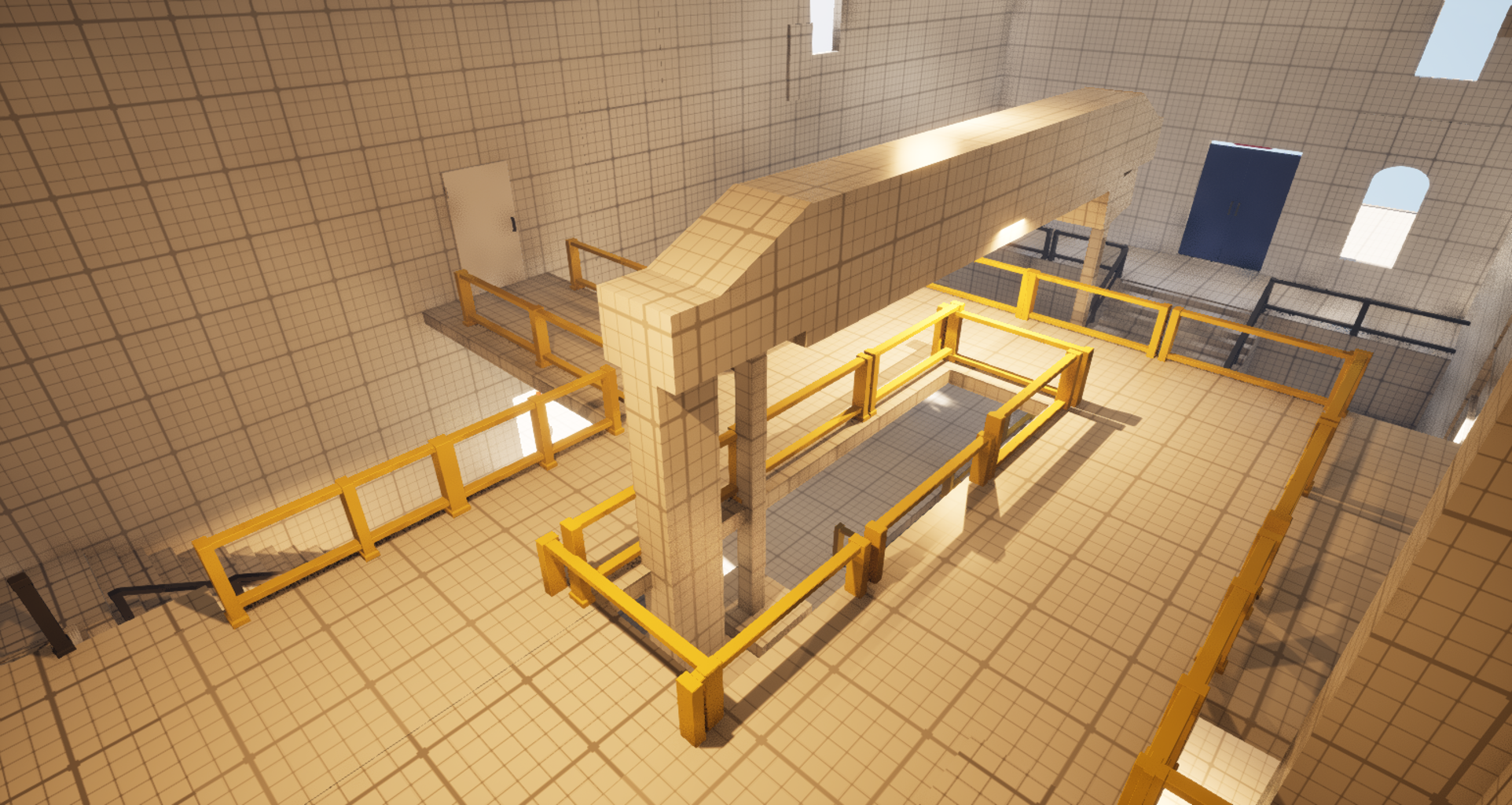
Early iterations of the Main Engine Room, the most heavily iterated space in the project. The challenge was maintaining the scale of the machinery without compromising player flow.
Phase 3: Gameplay, Loot & More Iteration
The gameplay was inspired by the building itself. As I developed the Main Engine Room, I knew I wanted the player to be able to climb the machinery and see the large flywheel come to life as the payoff for the player's exploration. This became the foundation for the main objective: ‘Restart the Engine Room Flywheel’. Similarly, the large cooling pool felt like it should play an active role in the gameplay rather than simply existing as scenery. Draining the pool became a way for the player to directly influence the environment while uncovering the Flywheel Control Key.
The secondary objective, Explore the Engineerium for Resources, encourages players to investigate optional buildings and discover hidden rewards beyond the critical path.
Phase 4: Polish
Knowing this project wouldn't receive an art pass, I invested more time in the environmental detail than I may do on a studio project. This allowed me to better communicate the atmosphere, and identity of each space.
I also spent time refining the player's approach to the Engineerium, ensuring the chimney gradually emerged through the trees. Experiencing this reveal in real life was what first inspired me to turn the British Engineerium into a level, so it felt important to recreate that moment for the player.
Reflections
My biggest challenge was time. I developed this project over several months alongside a full-time job and a long commute, so managing scope became an important part of the process. I had a much larger list of gameplay ideas, optional interactions, and exploration opportunities, but I had to consciously prioritise delivering a complete, playable experience first. Overall though, I'm really happy with how this project turned out. It reflects many of the level design principles I've learned throughout my career, while also showcasing my own design style and approach.
Tools Used: Unreal Engine 5, Adventure Game Locomotion System (AGLS) by Jakub W, Level Design Lobby Blockout Kit (trees, materials), Epic Games' Echo character.